Low Carb, Less Oil Lasooni Fish Tikka
by Viruthiga Veni
Loading rating...
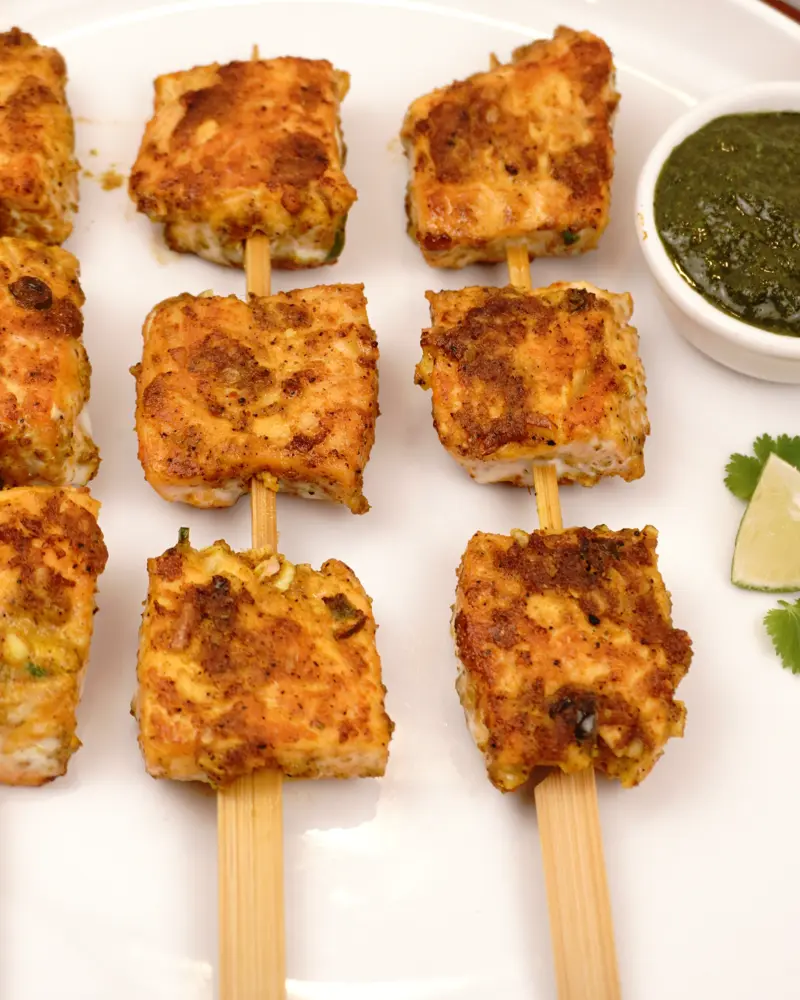
Fish tikka is a healthy, protein-rich dish that delivers bold flavor with little fat. This makes it an excellent choice for a healthy meal you can enjoy often. Because I use salmon, these tikkas are packed with heart-healthy Omega-3 fatty acids. Even with minimal oil, the salmon stays moist, tender, and tasty, making it the perfect low-carb option. This makes it an ideal fit for Keto, Paleo, and other weight-loss diets.
Ingredients
Skinless & Boneless fish pieces – 300 grams
Finely chopped garlic – 2 tsp (3 to 4 small size cloves)
Thick low fat/fat free curd – 2 tbsp (30 grams)
Lime juice – 1 tsp (1/4 medium size)
Finely chopped green chili – 1-2 tsp
Turmeric powder – ½ tsp
Garam masala powder – ½ tsp
Zeera powder – ½ tsp
Pepper powder – ½ tsp
Oat flour – 1/2 tbsp
Salt – ¾ tsp (approx.)
Oil – 1 tbsp
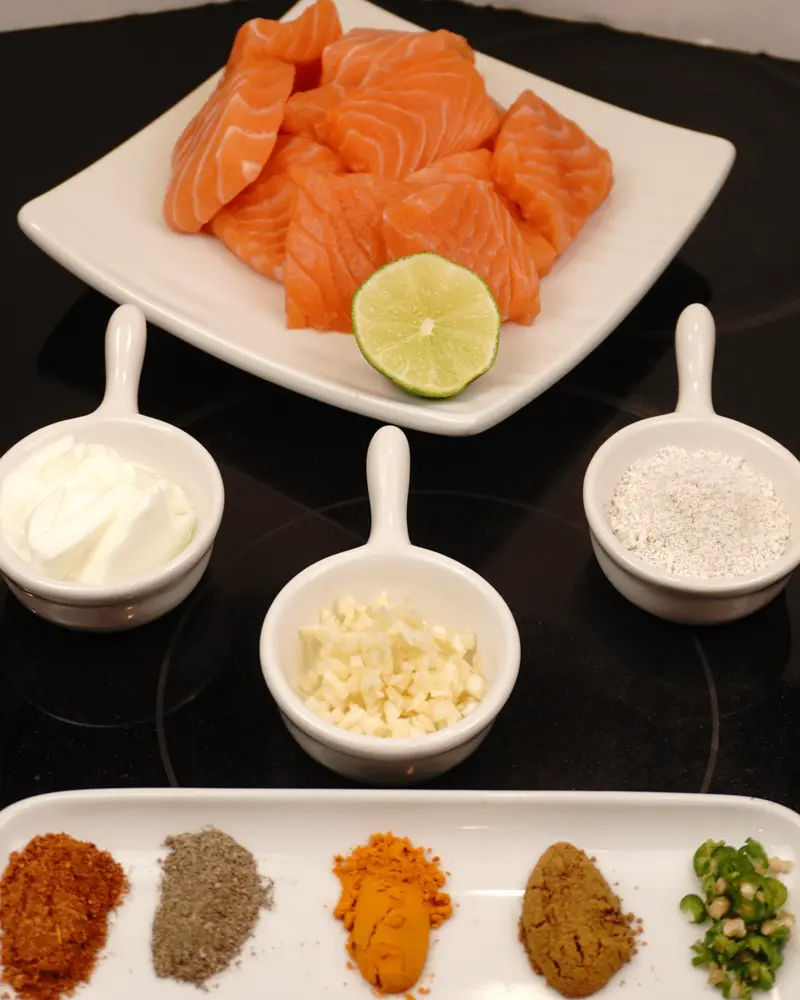
Gather and prepare the ingredients
Finely chopped garlic - Use a sharp knife or electric processor to chop them into very small pieces.
Thick low fat/fat free Curd/Yogurt: If it is already thick (like mine or using Greek yogurt, you can use it directly. If your curd is too thin or runny, place it in a fine-mesh strainer over a bowl for atleast 1 hour. This will drain the excess liquid and leave you with a thick curd for marinating chicken.
Ground spices - I used Everest garam masala powder, homemade zeera powder, chili powder, pepper powder and turmeric powder.
Oat flour : Plan ahead to make oats flour by placing the rolled oats in jar and pulse short bursts for several minutes until fine powder. Instead of oat flour, you can also use sorghum, chickpea, or almond flour.
Oil - I used olive oil. You can also use peanut, corn, vegetable, canola or sunflower oil.
Fish Fillet: Instead of salmon, you can also use trout, mahi-mahi, pomfret, or cod.
Prep fish pieces
Option 1: Dry Wipe (Recommended) - Skip rinsing the fish fillet entirely. Simply wipe the 300g fish fillet with a dry paper towel and dispose of the towel in the trash immediately. This is the safest way to prevent the spread of kitchen bacteria.
Option 2: - Rinse & Dry (Alternative): If you prefer to rinse the fish, do so quickly under a very gentle, low-pressure stream of cold running water to avoid splashing. Keep the fillet deep down inside the sink basin while rinsing. Transfer the fish directly to a clean, paper-towel-lined plate, pat it dry, and discard the paper towels right away.
Chop into Uniform Pieces
Place the dry fillet on a clean cutting board. Using a sharp kitchen knife, chop the fish fillet into uniform, 1-inch bite-sized cubes. Cutting them into equal sizes ensures that every single piece cooks at the exact same rate.
Making of first marination
Add the following ingredients to the small sized fish pieces
1 tsp lime juice
2 tsp finely chopped garlc
1/2 tsp salt
Instead of pouring them in one spot with a spoon, sprinkle it evenly over the fish pieces. Apply it to all sides of the pieces to ensure a uniform coating.
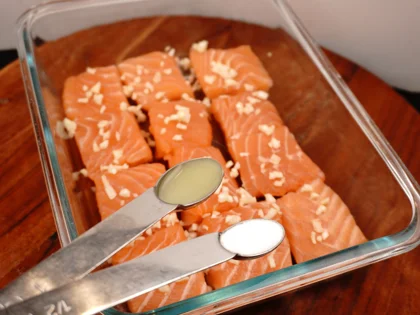
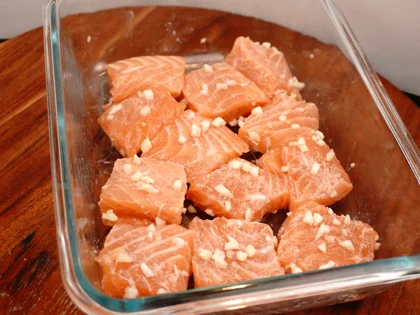
Making of second marination
Add the following ingredients in clean bowl and mix well
2 tbsp (30 grams) thick low fat/fat free curd
½ tsp turmeric powder, ½ tsp pepper powder, ½ tsp garam masala powder, ½ tsp chili powder.
½ tbsp(4 grams) oat flour, 1/8 tsp salt, 1 to 2 tsp finely chopped green chili.
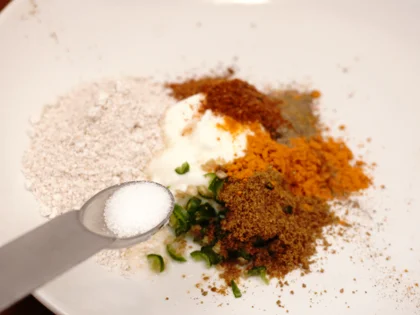
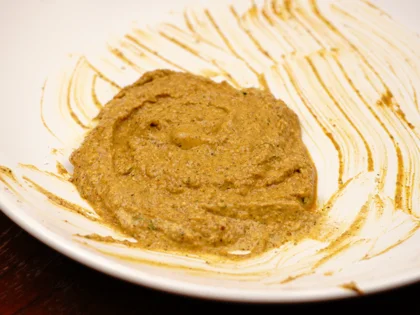
Applying the second marinade
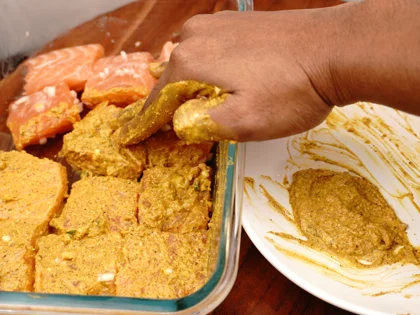
Using your hands, coat each piece of fish evenly with the marinade. Repeat this process for the remaining pieces until everything is well-coated.
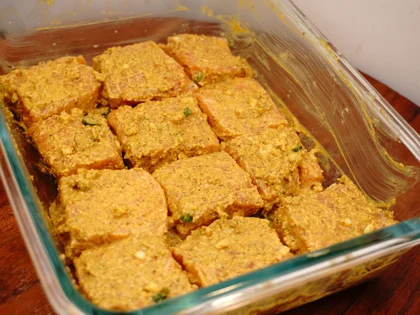
Place the marinated lasooni fish tikka in the room temperature for atleast 45 mintes to 1 hour.
Assembling the Fish pieces onto Skewers
Skewer the marinated fish piece
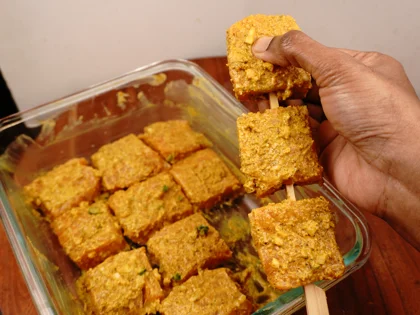
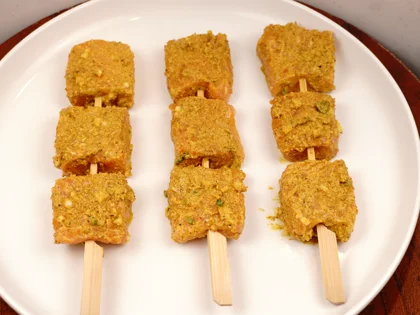
Thread each marinated fish piece onto the skewer, ensuring the skewer passes through the center for stability.
"Same-Size" Strategy - If your fish pieces vary in thickness, try to group them. Place thinner pieces together on one skewer and thicker pieces on another so you can adjust their cooking times accordingly.
Note: Make sure to leave a small space between the pieces.
Pan Selection and Cooking Spacing Guide
Why Use Non-Stick: It allows you to cook the fish pieces with less oil, prevents the fish from sticking, and makes cleanup much easier.
Option 1: Ceramic Non-Stick (Medium Heat): A premium ceramic coating safely works at medium heat. Leave plenty of space between the fish pieces so moisture can escape, helping you attain a light brown color.
Option 2: Hybrid or Seasoned Carbon Steel (Medium-High Heat): If using these durable pans, you can safely use medium high heat and leave a little space between the fish pieces while still achieving a light brown color.
Cooking of fish pieces in nonstick pan
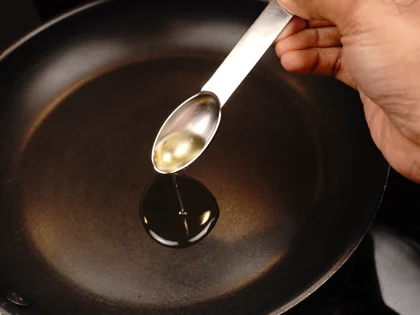
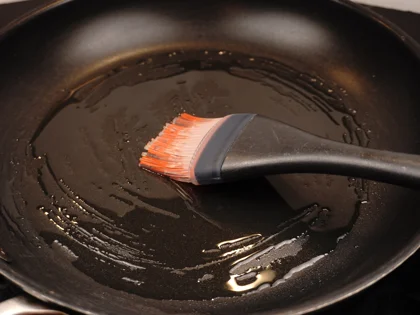
Oil and preheat the pan
Oil the pan - Add 1/2 tbsp oil to the pan. Use a pastry brush to spread the oil entirely in the bottom of the nonstick pan evenly. The usage of tsp of oil depends upon the size of your pan
Preheat- Preheat the pan for about 4 to 5 minutes over medium flame.
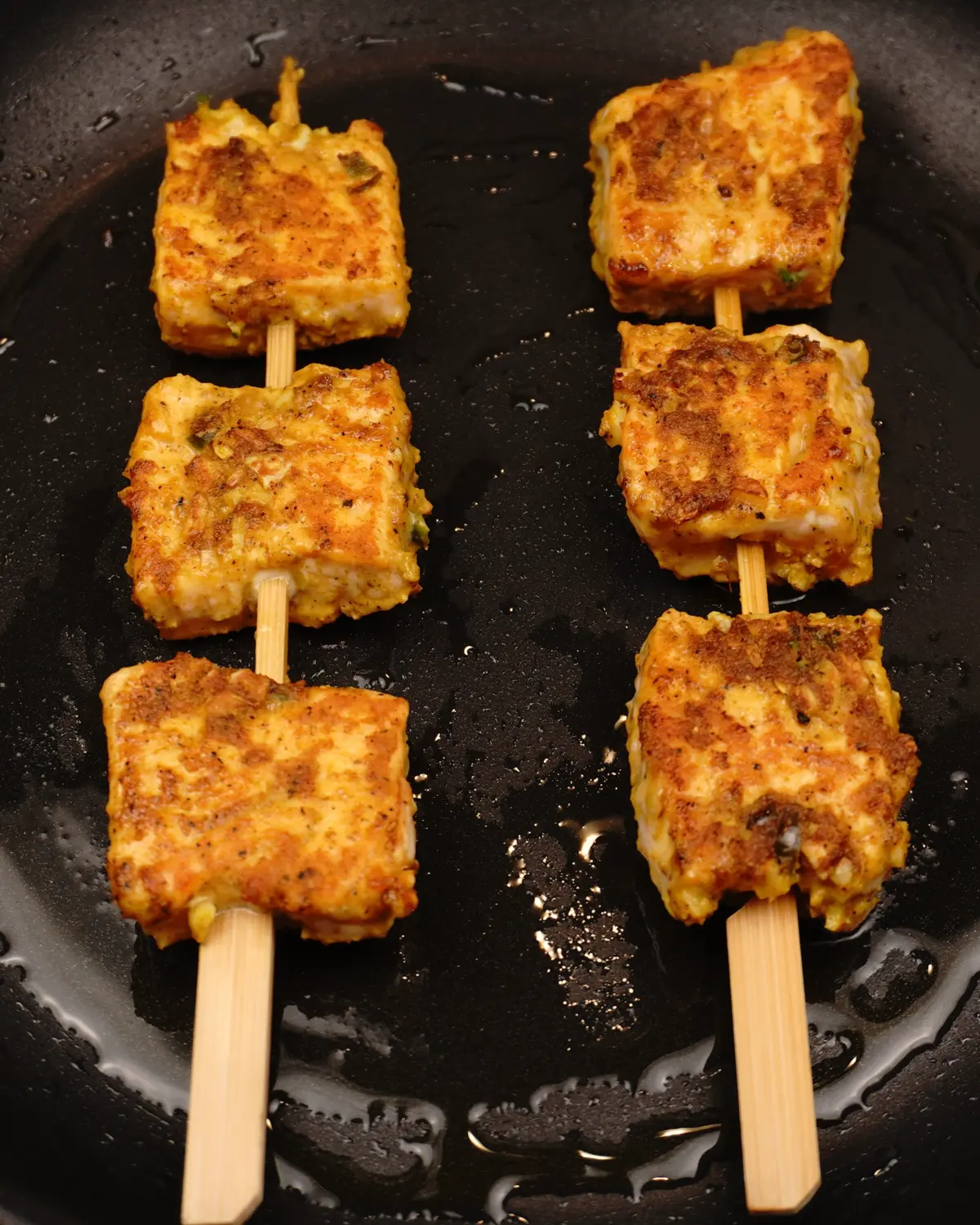
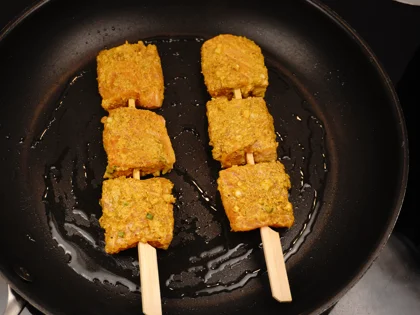
Cook the skewers first side until form light brown color over medium flame
Note: I used a ceramic non-stick pan at medium heat for this recipe.
Check the Heat- You will hear a Sizzling sound when you place the fish skewers in hot pan. Then the pan is ready.
Place and Cook- Place the fish skewers on the pan with more space between them. Cook over medium heat without moving them for 3 minutes.
Check and Flip- After 3 minutes, quickly peek by lifting the sides of the skewers, whether light brown color formed. Once formed then flip.
Note: Less oil in the pan can cause the fish skewers to burn easily, so don’t cook for too long on one side over a medium flame. Cook them until to attain light brown color.
Note :The pan should be hot enough to sizzle, but not smoking (too high) or failing to sizzle immediately (too low).
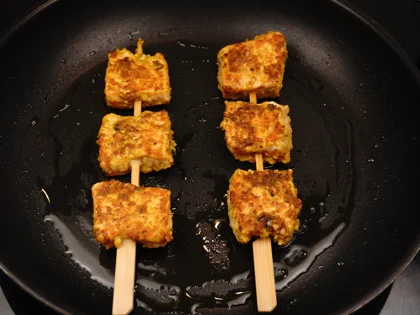
Cook the skewers on both thin sides then flip second flat side with closed lid
Both thin sides - Cook each side of the fish skewer for about 30 seconds.
Second side- Continue cooking the skewers for about 3 to 4 minutes.
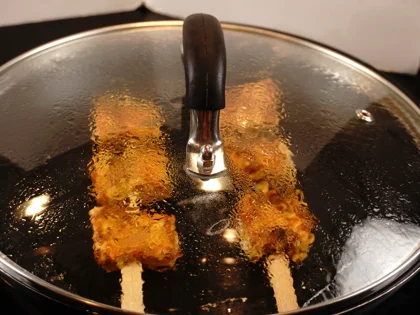
Low heat with lid closed - Reduce the heat to low and close the pan with lid. If the lid doesn’t have vent hole, close the pan with lid partially.
Remove Excess Moisture : After removing the lid, if the fish skewers still look slightly moist, cook them for a few more minutes uncovered. Continue cooking until the surface liquid has evaporated..
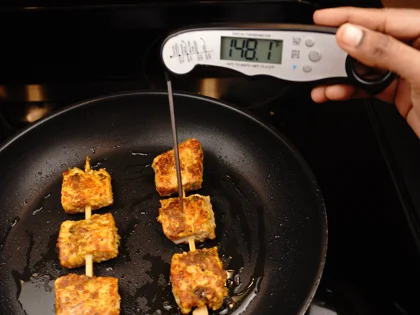
Check Doneness - Confirm the fish skewers are fully cooked by using a food thermometer to ensure the center reaches an internal temperature of 145°F (63°C). Alternatively, you can test by inserting a fork into the thickest part; if the fish flakes easily and separates along its natural lines, it is ready.
Total time- Total cooking time is usually 6–7 minutes per batch for 1/2 inch thick pieces.
Note - The cooking time will vary depending upon the thickness of the fish pieces and the amount of heat used.
Post-Cooking Steps before serving
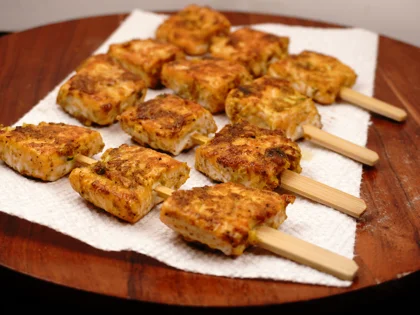
Drain and pat dry- Transfer the cooked skewers to a paper towel-lined plate. Using a fresh paper towel, gently pat all sides of the skewers to absorb the surface oil.
Transfer and cover- After a minute or two, move them to a clean plate and loosely cover them with a lid or foil to rest before serving.
Rest- Allow the kebabs to rest for a minimum of 5 to 10 minutes before serving.
Ready to serve
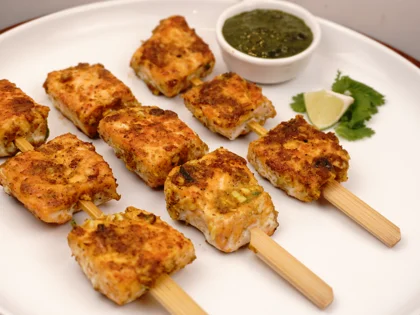
Serve: After the resting period is complete, the skewers are ready to be served alongside a cooling curd mint dip.
Tips
💡 Make sure to pat the fish fillet dry with a paper towel to remove surface moisture before you begin to chop and marinate it.
💡 Cut all fish pieces to the same thickness so they finish cooking at the same time. If your fish pieces vary in thickness, try to group them: place thinner pieces together on one skewer and thicker pieces on another so you can adjust their cooking times accordingly.
💡 If your curd/yogurt is too runny, you can thicken it by placing it in a strainer for about 1 hour to drain the excess liquid. If it is already thick (like mine or Greek yogurt), you can use it directly!
💡 Marinating with a spiced curd and salt mixture for at least 45 minutes to 1 hour is essential. It tenderizes the fish and ensures it is deeply seasoned and full of flavor.
💡 For a healthier option, use a non-stick pan and only 1 tablespoon of oil. Cook 300g of fish skewers in two batches (using half a tablespoon each) to ensure every piece gets a light golden color. You can do this in one batch if you are using a large enough pan.
💡 To get a light brown color, ensure the pan is hot enough to sizzle when placing the fish skewers, but not smoking (too high) or failing to sizzle immediately (too low).
💡 To Attain a light Brown Color: Arrange the fish skewers in a single layer, leaving plenty of space between them. If you are using a smaller pan, cook in multiple batches or switch to a larger pan
💡 My fish pieces were 1/2 -inch—so I only covered them after flipping. If yours are a thicker than 1/2 inch, you’ll need to cook them covered from start to finish.
💡 Overcooking fish skewers will make them dry, so to keep them juicy, cook them until the internal temperature reaches 145°F (63°C). For pieces with a 1/2-inch thickness, this usually takes about 5 to 7 minutes in total.
For Salt
💡 Be careful with your salt, as it affects both flavor and texture. Too little salt leaves the fish lacking flavor, while too much can make it tough. Remember that not all salts are the same; they have different levels of saltiness depending on the brand and type;for this recipe, I used 1/2 tsp of fine sea salt for 300g of boneless fish and 1/8 tsp for curd spice mixture.
Safe Taste-Testing
💡 Never taste the marinade once the raw fish has been added, as this can lead to food poisoning. To check the salt levels safely, fry a small sample piece of the fish and adjust the seasoning based on the cooked taste.
Frequently Asked Questions
The most likely reasons are that the pan is not hot enough and is overcrowded. Make sure the pan is hot and leave enough space between the skewers so they can light brown properly.
You can use these fish skewers in many different meals. Try chopping them up to use in fried rice, soups, or noodles. They also make an excellent filling for sandwiches, burgers, and chapati wraps, or you can use them as a savory stuffing for dosas and tacos.
You should pat dry fish fillet because it helps the marinade stick to the meat instead of sliding off. It also helps the fish brown better in the pan instead of steaming.
Yes! Marinating with a spiced curd and salt mixture for at least 1 hour is essential. It tenderizes the fish and ensures it is deeply seasoned and full of flavor.
Flipping only once on all sides prevents the delicate fish from breaking apart and allows a flavorful, light brown color to form.
Using flat wooden skewers is highly recommended because they prevent the fish pieces from rotating or spinning when you try to flip them. This ensures even cooking and a much better presentation.
Reuse the skewers - if wooden skewers are not burnt after cooking, you can wash them thoroughly and use them again. However, always inspect them for cracks or food residue to ensure they remain food-safe.
Yes. Its high protein content regulates hormones that control appetite, making you feel full for longer. Since it is low-carb, it is an ideal choice for Keto, Paleo, and other weight-loss diets.
Just put it in an airtight container and store it in the fridge immediately after cooling (and always within 2 hours of cooking). According to food safety guidelines, cooked fish lasts in the fridge for 3–4 days.
You Might Also Like

Low Carb, Less Oil Lasooni Fish Tikka Recipe
Fish tikka is a healthy, protein-rich dish that delivers bold flavor with little fat. This makes it an excellent choice for a healthy meal you can enjoy often. Because I use salmon, these tikkas are packed with heart-healthy Omega-3 fatty acids. Even with minimal oil, the salmon stays moist, tender, and tasty, making it the perfect low-carb option. This makes it an ideal fit for Keto, Paleo, and other weight-loss diets.
Ingredients
- 300 grams Skinless & Boneless fish pieces
- 2 tsp (3 to 4 small size cloves) Finely chopped garlic
- 2 tbsp (30 grams) Thick low fat/fat free curd
- 1 tsp (1/4 medium size) Lime juice
- 1-2 tsp Finely chopped green chili
- ½ tsp Turmeric powder
- ½ tsp Garam masala powder
- ½ tsp Zeera powder
- ½ tsp Pepper powder
- 1/2 tbsp Oat flour
- ¾ tsp (approx.) Salt
- 1 tbsp Oil
Instructions
-
Prep fish pieces
Option 1: Dry Wipe (Recommended) - Skip rinsing the fish fillet entirely. Simply wipe the 300g fish fillet with a dry paper towel and dispose of the towel in the trash immediately. This is the safest way to prevent the spread of kitchen bacteria.
Option 2: - Rinse & Dry (Alternative): If you prefer to rinse the fish, do so quickly under a very gentle, low-pressure stream of cold running water to avoid splashing. Keep the fillet deep down inside the sink basin while rinsing. Transfer the fish directly to a clean, paper-towel-lined plate, pat it dry, and discard the paper towels right away.
-
Chop into Uniform Pieces
Place the dry fillet on a clean cutting board. Using a sharp kitchen knife, chop the fish fillet into uniform, 1-inch bite-sized cubes. Cutting them into equal sizes ensures that every single piece cooks at the exact same rate.
-
Add the following ingredients to the small sized fish pieces
1 tsp lime juice
2 tsp finely chopped garlc
1/2 tsp salt
Instead of pouring them in one spot with a spoon, sprinkle it evenly over the fish pieces. Apply it to all sides of the pieces to ensure a uniform coating.
-
Add the following ingredients in clean bowl and mix well
2 tbsp (30 grams) thick low fat/fat free curd
½ tsp turmeric powder, ½ tsp pepper powder, ½ tsp garam masala powder, ½ tsp chili powder.
½ tbsp(4 grams) oat flour, 1/8 tsp salt, 1 to 2 tsp finely chopped green chili.
-
Applying the second marinade
Using your hands, coat each piece of fish evenly with the marinade. Repeat this process for the remaining pieces until everything is well-coated.
Place the marinated lasooni fish tikka in the room temperature for atleast 45 mintes to 1 hour.
-
Skewer the marinated fish piece
Thread each marinated fish piece onto the skewer, ensuring the skewer passes through the center for stability.
"Same-Size" Strategy - If your fish pieces vary in thickness, try to group them. Place thinner pieces together on one skewer and thicker pieces on another so you can adjust their cooking times accordingly.
Note: Make sure to leave a small space between the pieces.
-
Oil and preheat the pan
Oil the pan - Add 1/2 tbsp oil to the pan. Use a pastry brush to spread the oil entirely in the bottom of the nonstick pan evenly. The usage of tsp of oil depends upon the size of your pan
Preheat- Preheat the pan for about 4 to 5 minutes over medium flame.
-
Cook the skewers first side until form light brown color over medium flame
Note: I used a ceramic non-stick pan at medium heat for this recipe.
Check the Heat- You will hear a Sizzling sound when you place the fish skewers in hot pan. Then the pan is ready.
Place and Cook- Place the fish skewers on the pan with more space between them. Cook over medium heat without moving them for 3 minutes.
Check and Flip- After 3 minutes, quickly peek by lifting the sides of the skewers, whether light brown color formed. Once formed then flip.
Note: Less oil in the pan can cause the fish skewers to burn easily, so don’t cook for too long on one side over a medium flame. Cook them until to attain light brown color.
Note :The pan should be hot enough to sizzle, but not smoking (too high) or failing to sizzle immediately (too low).
-
Cook the skewers on both thin sides then flip second flat side with closed lid
Both thin sides - Cook each side of the fish skewer for about 30 seconds.
Second side- Continue cooking the skewers for about 3 to 4 minutes.
Low heat with lid closed - Reduce the heat to low and close the pan with lid. If the lid doesn’t have vent hole, close the pan with lid partially.
Remove Excess Moisture : After removing the lid, if the fish skewers still look slightly moist, cook them for a few more minutes uncovered. Continue cooking until the surface liquid has evaporated..
Check Doneness - Confirm the fish skewers are fully cooked by using a food thermometer to ensure the center reaches an internal temperature of 145°F (63°C). Alternatively, you can test by inserting a fork into the thickest part; if the fish flakes easily and separates along its natural lines, it is ready.
Total time- Total cooking time is usually 6–7 minutes per batch for 1/2 inch thick pieces.
Note - The cooking time will vary depending upon the thickness of the fish pieces and the amount of heat used.
-
Post-Cooking Steps before serving
Drain and pat dry- Transfer the cooked skewers to a paper towel-lined plate. Using a fresh paper towel, gently pat all sides of the skewers to absorb the surface oil.
Transfer and cover- After a minute or two, move them to a clean plate and loosely cover them with a lid or foil to rest before serving.
Rest- Allow the kebabs to rest for a minimum of 5 to 10 minutes before serving.
-
Ready to serve
Serve: After the resting period is complete, the skewers are ready to be served alongside a cooling curd mint dip.
Loading rating...
Write a Review
Loading reviews...